Key Takeaways
- At task level the work is alike: planned checks, structural and corrosion inspection, component replacement and documented findings. The differences sit in approvals, programme, engines and hangar fit.
- Under GCAA CAR-145, an approval for aeroplanes above 5,700 kg names the manufacturer, series or type and the engine type fitted. Base maintenance of large aircraft needs type-rated Category C certifying staff plus type-rated B1 and B2 support staff. A 737 approval isn’t an A320 approval.
- The A320 family comes with CFM56, V2500, PW1100G or LEAP-1A engines. Boeing’s Next-Generation 737 document lists only CFM56-7B variants.
- On size, wingspans match with winglets or sharklets (35.79 m against 35.80 m), while the 737-800 is 1.9 m longer (39.47 m against 37.57 m).
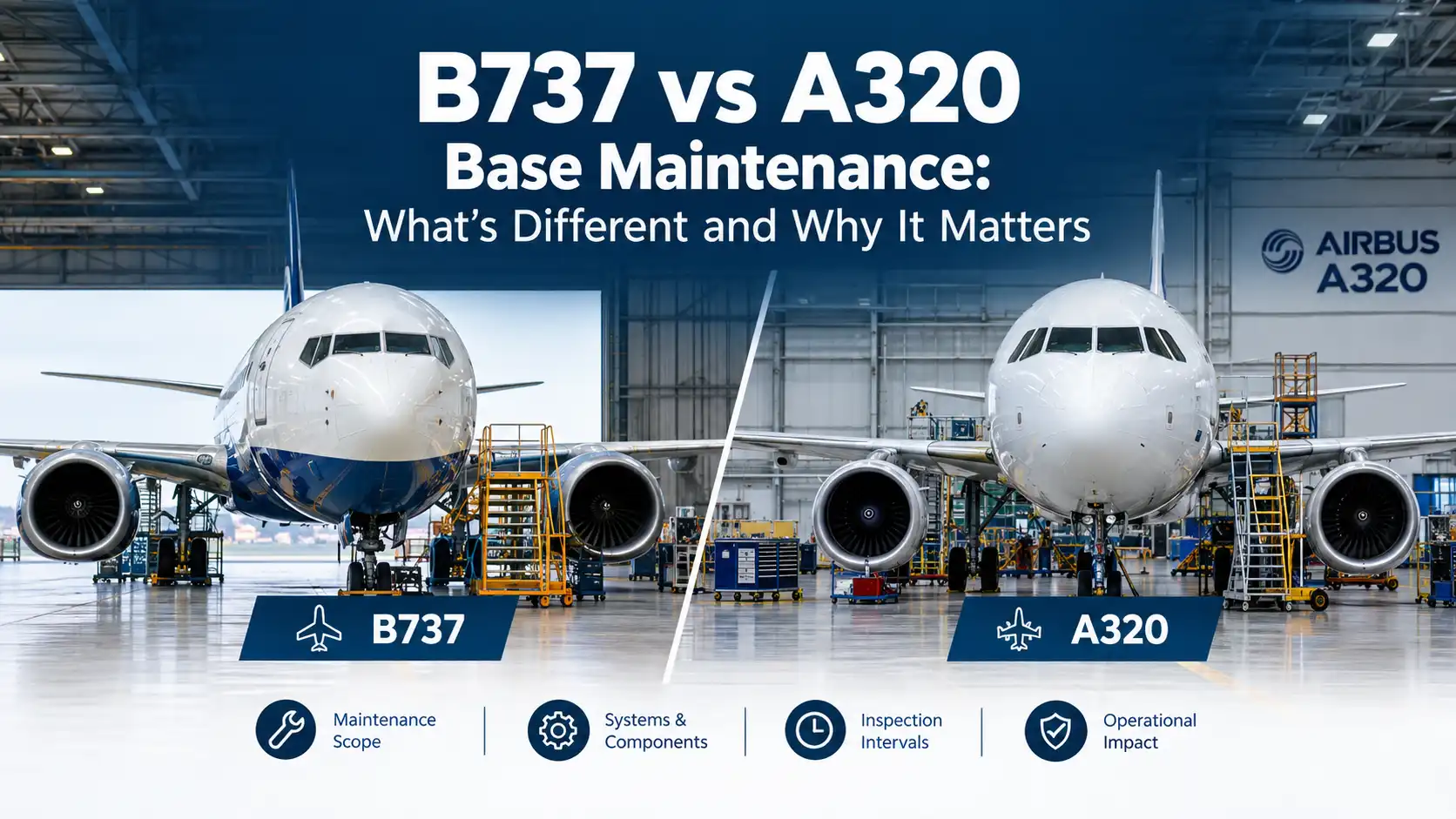
Operators with both Boeing 737 and Airbus A320 family aircraft often assume a base maintenance provider that handles one handles the other. The regulations, engines and dimensions say it isn’t automatic. This guide covers what is the same, what differs and what to check before booking a slot. For what base maintenance is in general, see our MRO guide.
What Stays the Same in a 737 or A320 Check?
The job. Our B737 and A320 base maintenance service covers scheduled checks against your approved maintenance programme and task cards, zonal and structural inspection, corrosion control and component replacement. Findings are raised, documented and agreed before rectification. That last point is a GCAA requirement: under CAR 145.50(c), new defects found during maintenance must be brought to the operator for agreement before they’re rectified.
Does an Approval for One Type Cover the Other?
No. GCAA’s CAR-145 Issue 09 sets out the approval classes. For Class A1, aeroplanes above 5,700 kg, the limitation shall state the aeroplane manufacturer, group, series or type, with the engine type fitted, and the maintenance tasks. So the scope can name one series or engine and not another.
People matter too. For base maintenance of large aircraft, CAR 145.30(h) requires appropriate type-rated certifying staff qualified as Category C, plus sufficient type-rated Category B1 and B2 staff to support them. The B1 and B2 staff confirm that tasks have been done to standard, and the Category C staff confirm the work package is complete before release. Certification authorisations follow the type ratings on each person’s licence (CAR 145.35(b)), so a team rated on the 737 isn’t automatically authorised for the A320, and the reverse is also true.
Whichever provider you consider, including us, ask to see the approval certificate and check that its scope covers your series, your engine type and the base maintenance work you need.
How Do the Engines Differ?
The engine fitted changes the scope, the tooling and the shop that supports it. Airbus’s airport and maintenance planning document for the A320 (revised June 2024) covers CFM56 and IAE V2500 engines on the A320-200, and PW1100G and CFM LEAP-1A engines on the A320neo. Boeing’s Next-Generation 737 document (October 2025) lists CFM56-7B variants, from the -7B18 to the -7B27.
Boeing also notes that the 737’s underwing engines give eye-level accessibility and that nearly all system maintenance may be performed at eye level. That is Boeing’s own description, so treat it as a design intent, not a comparison with the A320.
Will Both Fit the Hangar?
Nearly, but not exactly. Compare the official figures:
With sharklets or winglets the two spans are within a centimetre. The 737-800 is longer by about 1.9 m. Height needs care: Boeing gives the 737-800 as 12.55 m, while Airbus states its dimensions as related to aircraft attitude and weight, so get the A320’s tail clearance from the manufacturer’s data for the weight and attitude in your hangar. Whether a given hangar takes either type is something we confirm aircraft by aircraft. The same goes for variants: Airbus publishes a separate planning document for each of the A319, A320 and A321, and Boeing’s Next-Generation document covers the 737-600 to the -900ER, so figures for one model don’t carry across to another.
Why Does the Maintenance Programme Matter More Than a Rule of Thumb?
Because intervals change. In December 2004, Aviation Week reported that regulators had approved moving A320 family C checks from every 15 months to every 20 months or 6,000 flight hours. That is old data, which is the point: published figures date quickly. Your own approved programme sets the schedule, and we plan checks against it and your task cards.
Why Do Slot and Location Matter?
Because capacity is the scarce resource. As we put it on our service page, operators routinely ferry an aircraft several hours to find an available hangar slot, paying for the positioning flight, the crew and the fuel before a single task card is opened. At Sharjah International Airport, the aircraft moves from apron to hangar inside the airport perimeter, and because refinishing and storage run from the same facility, a check can be combined with a repaint or followed by protected storage without the aircraft leaving the site. Those are our own statements, so confirm slot dates and scope in your quote.
What Should You Ask a Base Maintenance Provider?
- Does the approval scope name your series and engine type?
- Are the Category C certifying staff and B1 and B2 support staff type-rated on your aircraft?
- Does the hangar take your variant, including winglets or sharklets?
- How are findings handled? Expect them to be agreed with you before rectification.
- Can other work be combined? Our site can run a check alongside refinishing or follow it with protected storage.
Frequently Asked Questions
Is B737 base maintenance different from A320 base maintenance?
The categories of work are similar, but approvals, certifying staff type ratings, engine options and the maintenance programme differ by type. A provider approved for one isn’t automatically approved for the other.
Can one CAR-145 approval cover both a 737 and an A320?
Yes, if its scope lists both. For aeroplanes above 5,700 kg, the approval limitation names the manufacturer, series or type, with the engine type fitted, so you need to read the scope.
Do the 737-800 and A320 fit in the same hangar?
Their spans are almost identical with winglets or sharklets, 35.79 m and 35.80 m, but the 737-800 is about 1.9 m longer. Confirm fit, including height, with the hangar operator.
What is base maintenance?
In-depth, hangar-based work such as structural inspection, corrosion control and component replacement, as opposed to quick at-gate line maintenance. Our MRO guide compares the two.
Plan a B737 or A320 Check
Tell us your type, the check package and your target dates, and our operations team will come back with slot availability and a realistic duration.


